Image

Back to Many Faiths

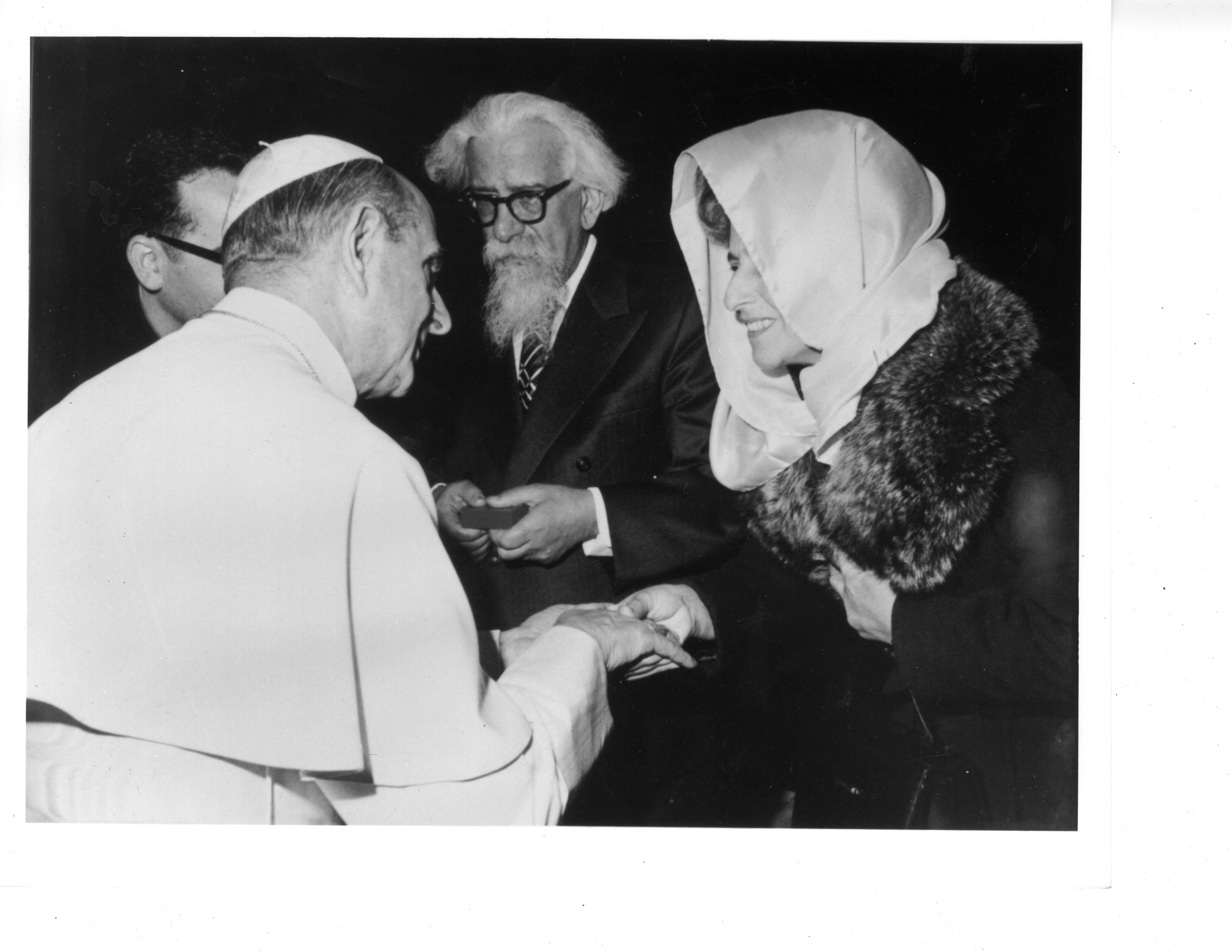
Meeting Pope Pius VI

When Pope Paul VI issued the the Declaration on the Relation of the Church with Non-Christian Religions, otherwise known as Nostre Aetate, it fundamentally shifted the relationship between Catholics and Jews. This process began under his predecessor, Pope John XXIII. Throughout the deliberations, Heschel was a key voice for Jewish values and concerns. When the Heschels visited Rome in the 1970s, they met with Pope Paul VI.

Additional Text:

Wide Horizons: Abraham Joshua Heschel, AJC, and the Spirit of Nostra Aetate
In Our Time: AJC and Nostre Aetate

Related Content

If I wanted to be credible in my work toward societal justice, then it was essential that I make him one of my mentors. Rabbi Jack Moline Here is this thinker whose words shaped the essence of how I think about Judaism. Rabbi Pamela Barmash, PhD What inspired me most is Heschel's involvement in Jewish-Christian dialogue. Dr. Stanislaw Obirek
Back to Many Faiths

Heschel at Reinhold Niebuhr’s Funeral

Reinhold Niebuhr’s funeral in Stockbridge, MA

Heschel gave the eulogy at his friend theologian Reinhold Niebuhr’s funeral in 1971. They had an intense, long-lasting friendship

Additional Text:

Notes on a Friendship: Abraham Joshua Heschel and Reinhold Niebuhr

An Unlikely Friendship on Seminary Row

When a Broader Religious Pluralism Began to Flower

Related Content

"Praying with Our Feet" Lapidus & Myles In The Sabbath, Heschel attempts to reawaken the spirituality and holiness of the Sabbath, and impart the wisdom and gifts it can bring to those who observe the Sabbath. Rebecca Katz Spiritual Audacity: The Abraham Joshua Heschel Story
Back to God & Humanity

Israel: An Echo of Eternity

Book Cover-Israel: An Echo of Eternity with wood cut menorah and Hebrew letters

Israel: An Echo of Eternity (1969)

Focused on the significance of the Jewish people, this book explores the historical and spiritual dimensions of Jewish identity. Heschel reflects on the enduring covenant between God and the Jewish people, emphasizing the responsibility to live in accordance with divine teachings. Heschel wrote this book following the Six Day War.

Related Content

Commitment to the divine imperative . . . empathy with the divine pathos. Rabbi Lenny Levin Spiritual Audacity: The Abraham Joshua Heschel Story Rabbi Heschel is quoted as having said we must fight nihilism. He meant it then, and if he were alive today, he would mean it now. Jane West Walsh, EdD
Back to Wonder

The Earth is the Lord’s

Book Cover-The Earch is the Lord's, with silver piece of Judaica

The Earth Is the Lord’s: The Inner World of the Jew in East Europe (1950):

Heschel provides a vivid and personal account of Jewish life in Eastern Europe before the Holocaust. Through his personal reflections, he captured the richness of Jewish spirituality, culture, and devotion, shedding light on a world that was tragically lost.

Related Content

He was given the gift of prophecy but also the gift of language to translate into human terms the divine concern. Rabbi Ernesto Yattah Heavenly Torah What inspired me most is Heschel's involvement in Jewish-Christian dialogue. Dr. Stanislaw Obirek
Back to Holy Time

The Sabbath

Book Cover-The Sabbat, with woodcut

The Sabbath: Its Meaning for Modern Man (1951)

Heschel explores the spiritual and ethical significance of the Sabbath in this classic work. He argues that the Sabbath is a sanctuary in time, providing a space for humans to connect with the divine and find rest from the demands of everyday life.

Related Content

How could one ever top an invitation from a brilliant scholar, my most unforgettable professor? Rabbi Moshe Pomerantz  Notre Dame's International Conference on "The Theological Issues of Vatican II" An invitation to Sabbath keeping that was at once thoroughly Jewish but also universally available—and more than that, necessary for our survival. Rev. Wil Gafney, PhD
Back to God & Humanity

Man Is Not Alone

Book Cover-Man is not Alone, golden dust jacket with image of Michaelango's Adam

Man Is Not Alone: A Philosophy of Religion (1951):

In this philosophical exploration, Heschel delves into the nature of religious experience and the relationship between humanity and God. He emphasizes the idea that true knowledge of God comes through a profound sense of awe and wonder.

Additional Content:

Heschel in Ottawa 1967, Exploring Man Is Not Alone

Related Content

I, in turn, found deep inspiration in those words. Rabbi Lizzi Heydemann Joining the JTS Faculty "Why We Pray With Our Feet: A Conversation with Cohosts Emelda and Trudy"
Back to God & Humanity

Man’s Quest for God

Book Cover-Man's Quest for God, with brown blocks
Book Cover-Man's Quest for God with rainbow

Man’s Quest for God: Studies in Prayer and Symbolism (1954):

In this book, Heschel explores the profound aspects of prayer and religious symbolism. He delves into the human quest for a meaningful connection with the divine, examining the role of prayer as a spiritual discipline and the symbols that facilitate this dialogue.

Related Content

King and Heschel at the Rabbinical Assembly Conference Whatever the yearning is that throbs within us—whether or not we call it the Holy Spirit—it is our responsibility to make it live. Edward K. Kaplan Commemorative Issue of Conservative Judaism
Back to God & Humanity

God in Search of Man

God in Search of Man: A Philosophy of Judaism (1955):

This book examines the dynamics of the human-divine relationship. Heschel explores the ways in which individuals can encounter God through prayer, ethical living, and religious commitment.

Related Content

He lives on in me in my social and interfaith activism, as I expect our partners to stand by us as we stand by them. Rabbi Susan Grossman Heschel at Reinhold Niebuhr's Funeral Heavenly Torah
Back to Justice

The Prophets

Book Cover-The Prophets, two colors red and gold

The Prophets (1962):

Heschel offers a comprehensive study of the Hebrew prophets in this influential work. He highlights the prophetic call to social justice and ethical behavior, emphasizing the prophets’ role in challenging injustice and promoting a deeper understanding of God’s will. This work was adapted from his dissertation Das prophetische Bewuβstein (Prophetic Consciousness).

Related Content

Heschel and the Vietnam War I may not have been an actual classroom student of Heschel's, but I could, and did, stand on his shoulders.   Rabbi Jim Rudin The first Jewish text included on our syllabus was a chapter from Heschel’s God in Search of Man, and I was entranced by it. Rabbi Geoffrey Claussen, PhD
Back to Justice

Who Is Man?

Book Cover-Who is Man

Who Is Man? (1965)

Heschel reflects on the nature of humanity and the purpose of existence in this philosophical work. He discusses the unique qualities that distinguish humans from other beings and explores the ethical responsibilities that come with human existence.

Related Content

Rabbi Elliot Cosgrove 50th Yahrzeit Sermon Heschel’s emphasis on the need for “text-people,” prompted me to know that his life of learning, inspiration, and activism was Torah. Rabbi Elie Spitz Protest can be a form of prayer, heard both in the rhythm of the psalms and soles on pavement. Reverend Jamie Washam, PhD