Image

Back to Prayer

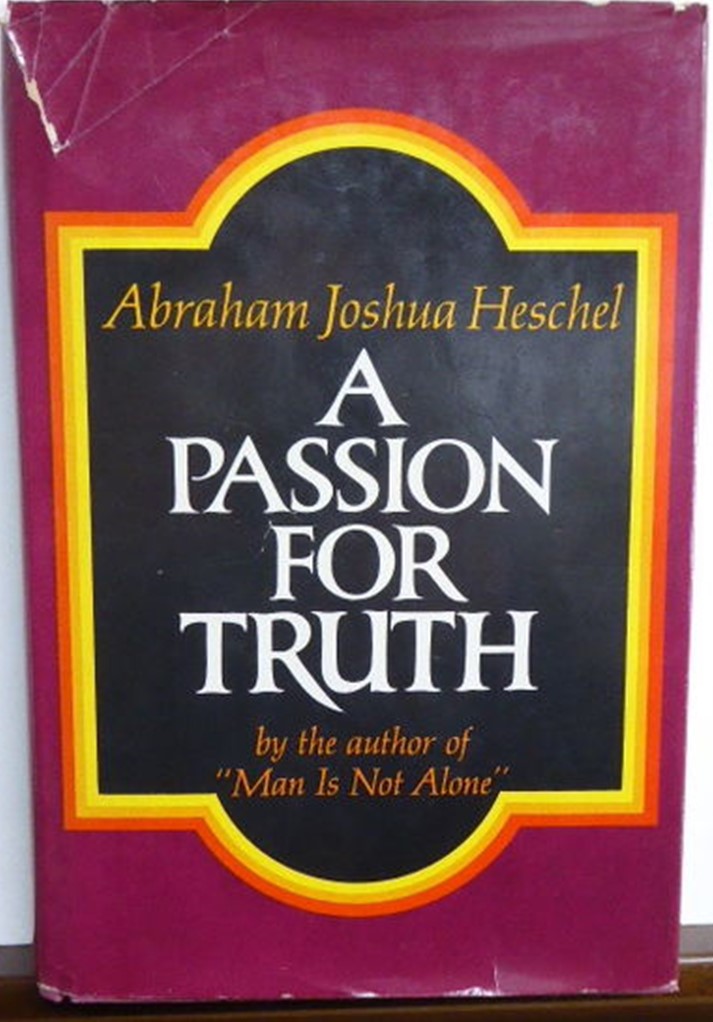
A Passion for Truth

A Passion for Truth (1973)

This book was published posthumously and is significantly autobiographical. It compares and contrasts the life and thought of the enigmatic Hasidic Rebbe Menahem Mendl of Kotzk with that of the Danish philosopher Søren Kierkegaard. A secondary contrast that is that between the Baal Shem Tov (considered the founder of Hasidism) and the Kotzker Rebbe, a duality that Heschel maps onto the mind and soul.

Related Content

Psalm 42: Text and Commentary An invitation to Sabbath keeping that was at once thoroughly Jewish but also universally available—and more than that, necessary for our survival. Rev. Wil Gafney, PhD Heschel at Reinhold Niebuhr's Funeral
Back to Justice

Moral Grandeur and Spiritual Audacity

Book Cover-Moral Grandeur and Spiritual Audacity, with bright image of trees

Moral Grandeur and Spiritual Audacity: Essays (1996)

This collection of essays, compiled and edited by Heschel’s daughter Dr. Susannah Heschel, touches on Heschel’s moral and spiritual reflections on various topics, such as social justice, ethical responsibility, and the moral challenges of the modern world. Heschel’s impassioned voice encourages readers to embrace moral grandeur and spiritual audacity in their lives.

Related Content

Heschel at Reinhold Niebuhr's Funeral The encounter vividly encompasses for me Heschel's remarkable qualities . . . not only his warmth, caring, humor, and humanity, but his insistence on rigorous and careful scholarship.  Rabbi Eli Schochet Rabbi Heschel inspired me to start an online community and podcast. Emelda DeCoteau
Back to Prayer

Heavenly Torah

Heavenly Torah: As Refracted Through the Generations (2005)

This work is a translation (with commentary for the reader) of Heschel’s three-volume work in Hebrew on the different theologies (Torah Min Hashamayim) of the Rabbis of the Talmudic period and how those theologies lived on and confronted one another in later periods. The first two volumes of the original work were published in 1962 and 1965, respectively. The third Hebrew volume was published posthumously in 1990. The English translation by Rabbi Gordon Tucker was published in 2005.

Related Content

Shabbat went from something I did to somewhere I dwelled Rabbi Elyse Winick My own identity became renewed by the idea that Judaism and Jewish values and Jewish actions could be and should be brought to the streets. Rabbi David Steinhardt Heschel in Ottawa, 1968 or 1969, Exploring "Shabbat as Spiritual Sanctuary"
Back to Justice

The Insecurity of Freedom

Book cover-The Insecurity of Freedom, black jacket with white text.

The Insecurity of Freedom (1966)

This collection of essays explores a range of theological, philosophical, and ethical topics. The essays reflect Heschel’s deep concern for the moral challenges of the time, particularly in the context of the Vietnam War and the broader social and political issues of the 1960s.

The central theme of the book revolves around the tension between freedom and security. Heschel examines the complex relationship between individual freedom and the responsibilities it entails. He discusses the moral dilemmas faced by individuals in a society marked by injustice, violence, and ethical uncertainties.

Related Content

"No Religion is an Island" Invitation The first Jewish text included on our syllabus was a chapter from Heschel’s God in Search of Man, and I was entranced by it. Rabbi Geoffrey Claussen, PhD I, in turn, found deep inspiration in those words. Rabbi Lizzi Heydemann