Justice

Back to God & Humanity

Rabbi David Steinhardt

My own identity became renewed by the idea that Judaism and Jewish values and Jewish actions could be and should be brought to the streets.

Bnai Torah Congregation
A Jewish Perspective

Where did you first encounter Heschel’s work?

I was first “introduced” to Heschel when my mother came home from a talk Heschel gave in 1963 at my synagogue. I was only 10 years old, but I have a vivid memory of my mother’s enthusiasm. She was from a rigid orthodox “yekke” family. That night she was exposed to a visionary, a philosopher, a freedom fighter, a humanist steeped in tradition. And she said: “One day, David, you will have to hear him.” I believe he renewed her sense of being Jewish in the post-Holocaust world.

In high school I read some Heschel and was exposed to his thought through teachers from JTS at my shul and Ramah. And I was alive and aware during the Vietnam War days and the struggles for civil rights. My own identity became renewed by the idea that Judaism and Jewish values and Jewish actions could be and should be brought to the streets, to the community, to the fight for social justice, freedom, and the deeper places where the spirit resided.

I met Rabbi Heschel in 1970 in the cafeteria at JTS long before my college or rabbinical school years. My teacher had brought me to NYC to pick up some work he had submitted to Heschel. One memory from that moment: this man of greatness was very interested in speaking to me and hearing about me.
Related Content

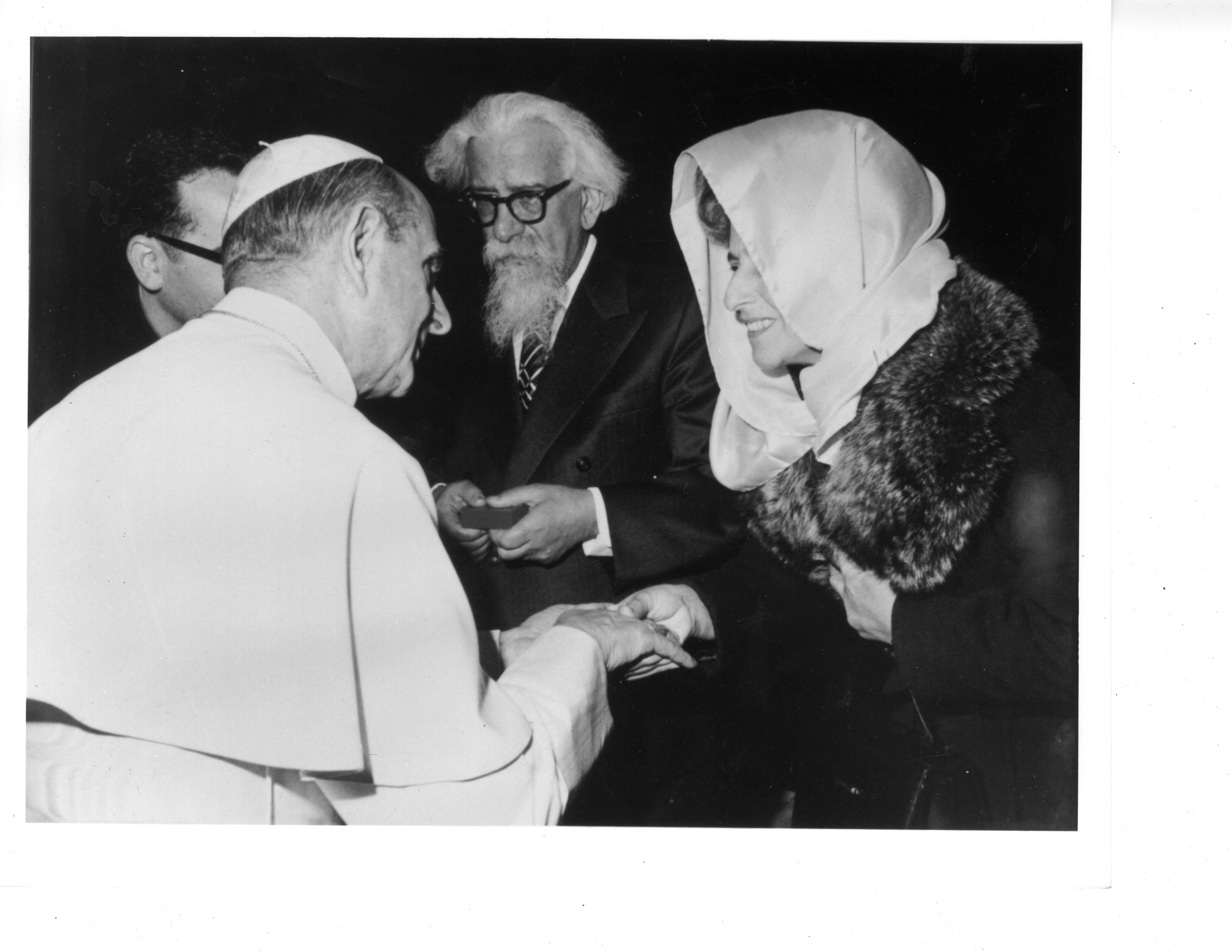
Meeting Pope Pius VI Heschel’s confidence in the power of the tradition was a constant example throughout his life. Rabbi David Wolpe That book [The Prophets]—almost more than any other—set me on the course that eventually became my life.  Rabbi Martin Cohen, PhD
Back to Heschel's Influence

Reverend Jamie Washam, PhD

Protest can be a form of prayer, heard both in the rhythm of the psalms and soles on pavement.

First Baptist Church in America
Providence, Rhode Island
An American Baptist Perspective

Where did you first encounter Heschel’s work?

As a student in divinity school.

How did Heschel and his thinking inspire your work, religious life, or civic engagement?

In the late 1990s, the Rev. Dr. Vincent Harding offered a course on Beloved Community at Harvard Divinity School. He taught about how Rabbi Abraham Joshua Heschel marched alongside the Rev. Dr. Martin Luther King, Jr., and others in the struggle for civil rights. The idea of praying with our legs and feet opened my concepts of embodied faith. Petitions for justice and peace take root in deep intercession and thrive in community. Heschel’s embrace of active service as a complementary mode of prayer expanded my theology and practice. Alongside faith, he urged leaps of action towards the righteous world we desire to inhabit. Protest can be a form of prayer, heard both in the rhythm of the psalms and soles on pavement.

Decades later, I heard Heschel’s call put to music by Paul Vasile, in his song, “Pray with Our Feet.” May the teachings of this good rabbi continue to inspire action and awe for generations.

It’s not enough to offer thoughts and prayers.
It’s not enough to say that we care.
It’s not enough to hope that things will change.
We’ve got to pray with our feet,
pray with our feet, pray with our feet
and get out, out on the street.

Paul M. Vasile, LovedIntoBeing Music ©2018

Gallery

  • https://soundcloud.com/paulmvasile/pray-with-our-feet?utm_source=clipboard&utm_campaign=wtshare&utm_medium=widget&utm_content=https%253A%252F%252Fsoundcloud.com%252Fpaulmvasile%252Fpray-with-our-feet

Related Content

The first Jewish text included on our syllabus was a chapter from Heschel’s God in Search of Man, and I was entranced by it. Rabbi Geoffrey Claussen, PhD Heschel in Ottawa, 1968 or 1969, Exploring "Shabbat as Spiritual Sanctuary" What inspired me most is Heschel's involvement in Jewish-Christian dialogue. Dr. Stanislaw Obirek
Back to Heschel's Influence

Dr. Shoshana Ronen

It is a guide for my life, not to be indifferent, to be engaged socially, and not to close myself in a ivory tower.

University of Warsaw
Poland

Where did you first encounter Heschel’s work?

It was about 20 years ago when Stanislaw Obirek recommended that I read Heschel.

How did Heschel and his thinking inspire your work, religious life, or civic engagement?

Heschel was not only a philosopher and theologian but also a poet. I love his Yiddish poems almost as much as I love his philosophy. So it is a pleasure to read his works, all of them, because he wrote so beautifully. Because of his work I became, as an atheist, more open to spirituality and faith as such. I also share his powerful criticism of religious institutes and establishment. I was much struck by his book The Prophets. Not only because it is insightful and beautiful but also because it is so much connected to his social engagements. He shows that the morality of the prophets can guide us morally, even today.

The most compelling quote of Heschel is “Perhaps not all of us guilty, but all of us are responsible.” For me it is a guide for my life, not to be indifferent, to be engaged socially, and not to close myself in a ivory tower. It is such a powerful quote, because it treats all human beings as rational and moral adults. It is especially important today when choosing to be a victim is so widespread. Heschel says, “Do not think about yourself as a helpless person who suffers, but form your suffering into an action of helping others who suffer even more than you. You are strong enough to do that. You are a worthy and powerful human being and not a passive object or an egoistical immature child.” If we all followed this message, the world would be much better.

Heschel’s ethics of responsibility is a powerful inspiration. It also makes his Judaism so humble and accepting. I wish it were an inspiration for all the Jews. I’m very much concerned with what is going on with Jewish mutations, or sects, especially in Israel. There is nothing in common with them and Heschel’s caring for all human beings. Heschel’s God of pathos is based on tikkun olam for all humanity, with no exclusion of any group. I appreciate very much his Torah min Hashamayim, because it shows that his interpretation of Judaism is well established on Jewish sources.

What of Heschel lives in you?

His social collaboration with Martin Luther King, Jr., his theology after Auschwitz and his affirmation of life, his benevolence (for example, toward the plagiarist of his PhD), his commitment to dialogue (which I believe was a result of the Holocaust), and his passion for truth.

Additional Text:

I Am What I Do: Abraham Joshua Heschel Seen from Two Perspectives, Secular Jewish and Christian

Related Content

Man's Quest for God My own identity became renewed by the idea that Judaism and Jewish values and Jewish actions could be and should be brought to the streets. Rabbi David Steinhardt The idea of revelation as a partnership to which both God and the people Israel make a contribution is at the core of Heschel's theology. Dr. Benjamin Sommer
Back to Heschel's Influence

Dr. Shawn Parry-Giles

His words are as profound and meaningful in 2023 as they were in 1963.

University of Maryland
College Park, Maryland
A Protestant Perspective

We published a unit on Rabbi Heschel’s 1963 speech “Religion and Race” with our online Voices of Democracy project. I believe it is one of our more powerful units in our growing collection of speeches and essays because of Heschel’s strong commitment to civil rights in the heart of the Civil Rights Movement. His words are as profound and meaningful in 2023 as they were in 1963. The image of Heschel and King marching together is a poignant reminder that we need to work collectively and find commonality if we are to create more just and nonviolent communities.

Let us dodge no issues, let us yield no inch to bigotry, let us make no compromise with callousness.

From his 1963 speech on “Religion and Race”

Related Content

Psalm 42: Text and Commentary Commemorative Issue of Conservative Judaism Most importantly to me, he wasn't afraid to use his talents and unique perspective to push for America to be a better version of itself. Ruth Messinger
Back to Heschel's Influence

Dr. Stanislaw Obirek

What inspired me most is Heschel's involvement in Jewish-Christian dialogue.

University of Warsaw
Poland
A Christian Perspective

Where did you first encounter Heschel’s work?

Heschel’s prominent students Rabbi Byron L. Sherwin and Professor Harold Kasimow told me about their master.

How did Heschel and his thinking inspire your work, religious life, or civic engagement?

It is a very difficult question for me, because each of books affected me in different way. But if I have to mention one, I will say that his essay “No Religion Is an Island” shaped my perception of Judaism as a dialogical religion and Christianity as a religion closely related to its mother religion. Reading The Prophets was a revelation for me, showing the common ground for both religions which should be a sensitivity to the suffering of poor people. Honestly I cannot think about myself as a Christian and follower of Jesus of Nazareth for whom religion was a religion of the prophets of Hebrew Bible without the books by Abraham Joshua Heschel.

What of Heschel lives in you?

For me the most important from Heschel’s legacy is his commitment to social justice and his passion to transmit to others the beauty of belief in the God of the Hebrew Bible. What inspired me most is Heschel’s involvement in Jewish-Christian dialogue and his contribution to the declaration Nostra Aetate of the Second Vatican Council.

Perhaps it is the will of God that in this eon there should be diversity in our forms of devotion and commitment to Him. In this eon, diversity of religions is the will of God.

Related Content

I, in turn, found deep inspiration in those words. Rabbi Lizzi Heydemann Rabbi Heschel is quoted as having said we must fight nihilism. He meant it then, and if he were alive today, he would mean it now. Jane West Walsh, EdD How could one ever top an invitation from a brilliant scholar, my most unforgettable professor? Rabbi Moshe Pomerantz 
Back to Heschel's Influence

Reverend Johnnie Moore

Rabbi Heschel taught the Bible and linked it to our present time with effortless elegance. 

The Congress of Christian Leaders
Washington DC
A Baptist Perspective

Where did you first encounter Heschel’s work?

I don’t remember the exact time, but it must have been when I was in my early 20s. I was the campus pastor at Liberty University, and I encountered Rabbi Heschel’s book The Sabbath.  As a young evangelical growing up in the Baptist tradition, I felt a powerful love for the Jewish community, but I had never read any theological text written by a Jewish rabbi. I shortly thereafter discovered his book The Prophets and used it heavily when preparing sermons on the prophets of the Hebrew Bible. In many ways, discovering Heschel launched me into a lifelong passion for Jewish texts. At this very moment, a copy of The Prophets sits on my desk (a gift from a rabbi mentor of mine) and it sits next to several other books by Rabbi Jonathan Sacks, Rabbi Lau’s three-volume commentary on Pirkei Avos, Rabbi Soloveitchik’s book On Repentance, and a copy of some Chofetz Chaim readings. I’ve found a deeper understanding of my own faith by engaging substantively with rabbinic commentaries on the Hebrew Bible. My relationship with Jews and Judaism isn’t sentimental any longer. It is about shared learning and shared serving.

How did Heschel and his thinking inspire your work, religious life, or civic engagement?

As a millennial evangelical, I felt a commonality with Heschel’s passion for justice and the fact that he still taught the biblical text seriously. His teaching gives us a prophetic theology that isn’t political theology, per se. His sermons shook the foundations of the culture, but they were still sermons drawn from and anchored in the biblical text. Sometimes, clergy preach politics and shimmy in the Bible. Rabbi Heschel taught the Bible and linked it to our present time with effortless elegance. 

I really love the remarks he delivered on the first occasion he and Rev. Dr. Martin Luther King, Jr., shared a pulpit.

What of Heschel lives in you?

Heschel always challenges me to leave my comfort zone, to embrace righteousness and justice, and to know that the Bible says something about all of it.  

Related Content

Heschel's ideas about prophecy, radical amazement, and communal responsibility have inspired me for decades. Rabbi Dan Orenstein God in Search of Man Joining the JTS Faculty
Back to Heschel's Influence

Orly Erez Likhovski

I was inspired by the Jewish concept of working for social change.

Israel Religious Action Center
Israel
A Jewish Perspective

How did Heschel and his thinking inspire your work, religious life, or civic engagement?

I was inspired by the Jewish concept of working for social change, promoting equality and dignity in the name of the Judaism. This is especially vital these days when the Israeli government is espousing a very narrow version of Judaism that is completely opposite to what Heschel believed in.

What of Heschel lives in you?

The image of Heschel marching in Selma together with Martin Luther King, Jr., is powerful and is on my mind when we march for peace and coexistence in Jerusalem or when we march with Torah scrolls at the entrance to the Western Wall.

Related Content

I, in turn, found deep inspiration in those words. Rabbi Lizzi Heydemann He was given the gift of prophecy but also the gift of language to translate into human terms the divine concern. Rabbi Ernesto Yattah Heschel’s emphasis on the need for “text-people,” prompted me to know that his life of learning, inspiration, and activism was Torah. Rabbi Elie Spitz
Back to Heschel's Influence

Lapidus & Myles

He imbued in us a sense of wonder and a commitment to justice.

Micah Lapidus and Melvin Myles
Musicians
The Davis Academy, The Temple, Ebenezer Baptist Church
Atlanta, Georgia
An Interfaith Perspective

Rabbi Micah Lapidus first encountered Heschel as a young learner at Los Angeles Hebrew High School. Melvin Myles first encountered Heschel through Ebenezer Baptist Church’s partnership with The Temple in Atlanta.

Heschel is an inspiration in many ways. Most relevant here is that he is the inspiration for the composition “Praying with our Feet,” written by Rabbi Micah Lapidus and performed by Lapidus and Melvin Myles, often accompanied by the Ebenezer Baptist Church and Temple choirs.

He imbued in us a sense of wonder and a commitment to justice.

Gallery

Related Content

An invitation to Sabbath keeping that was at once thoroughly Jewish but also universally available—and more than that, necessary for our survival. Rev. Wil Gafney, PhD Spiritual Audacity: The Abraham Joshua Heschel Story How could one ever top an invitation from a brilliant scholar, my most unforgettable professor? Rabbi Moshe Pomerantz 
Back to Heschel's Influence

Emelda DeCoteau

Rabbi Heschel inspired me to start an online community and podcast.

Podcaster, Pray with Our Feet
Baltimore, Maryland
A Christian Perspective

Where did you first encounter Heschel’s work?

Several years ago, I was searching for a connection between activism and faith. For as long as I can remember, I have felt drawn to speaking out against injustice, but sadly, didn’t find a place for it in many church spaces. One day, while reading about Dr. King’s later years and writings, I stumbled across a short blog post on Rabbi Heschel and his involvement with the Civil Rights Movement.

How did Heschel and his thinking inspire your work, religious life, or civic engagement?

Rabbi Heschel inspired me to start an online community and podcast (which I cohost with my mom), Pray with Our Feet. We highlight the intersection of progressive Christianity and social justice through interviews with ministers, activists, artists, and thinkers.

The idea came alive after reading about Rabbi Heschel’s involvement in the Civil Rights Movement and commitment to seeing faith and activism as deeply connected.

There’s an incident from his life that really resonates with me because it lifts up how central faith is along our journey to creating a better world (described here):

When Rabbi Heschel returned from Selma, he was asked by someone, ‘Did you find much time to pray, when you were in Selma?’ Rabbi Heschel responded, ‘I prayed with my feet.’ What was his point? That his marching, his protesting, his speaking out for Civil Rights was his greatest prayer of all.

Rabbi Heschel’s legacy is one of activism built upon his relationship with God. He challenged us to see each other as human beings created in the image of God. Only then can we love, esteem, and value others. After 50 years, his voice is that of a modern-day prophet reminding each of us that racism is the ultimate evil perpetuated by humanity.

What of Heschel lives in you?

Heschel’s commitment to human rights, antiracism, and love for humanity and God live within us. These values (which he beautifully embodied) drive the work Mom and I do together, and ground us in a deeper presence with the world. Heschel often spoke of the wonder and amazement of God:

Our goal should be to live life in radical amazement . . . Get up in the morning and look at the world in a way that takes nothing for granted. Everything is phenomenal; everything is incredible; never treat life casually. To be spiritual is to be amazed.

His words, legacy, and life push us to awaken continually.

Related Content

He lives on in me in my social and interfaith activism, as I expect our partners to stand by us as we stand by them. Rabbi Susan Grossman JTS Memorial Service for Martin Luther King Jr "Be Here Tomorrow" Podcast with Kenyon Phillips
Back to Heschel's Influence

Rabbi Aryeh Cohen

Heschel's life was a life of prophetic agitation in which he saw his role as pushing the Jewish community beyond their comfort zones.

American Jewish University
Los Angeles, California
A Jewish Perspective

Where did you first encounter Heschel’s work?

In graduate school at Brandeis, I read Torah min Hashamayim. Subsequently I edited (an ultimately unpublished) translation of the books.

How did Heschel and his thinking inspire your work, religious life, or civic engagement?

In certain ways Heschel is used as a fig leaf; the picture of him and MLK on the bridge is trotted out every year on MLK Day as a proof text that the Jewish community is on the right side of history. But we’re not, on the whole, and Heschel's life was a life of prophetic agitation in which he saw his role as pushing the Jewish community beyond their comfort zones, out of the synagogues and the federation buildings and into the streets.

What of Heschel lives in you?

His combination of Hasidic transcendence and awe (which I don’t have, but wish I did) and political courage beyond the walls of the university.

Additional Writing:

From JTS to Riverside Church

Related Content

His presentation of the unique Jewish foundation of the 'cathedral in time.' Michal Govrin Heschel at Reinhold Niebuhr's Funeral Justice is the balance between created and creator! Itay Seith