Justice

Back to Justice

Anti-war March on Arlington Cemetery
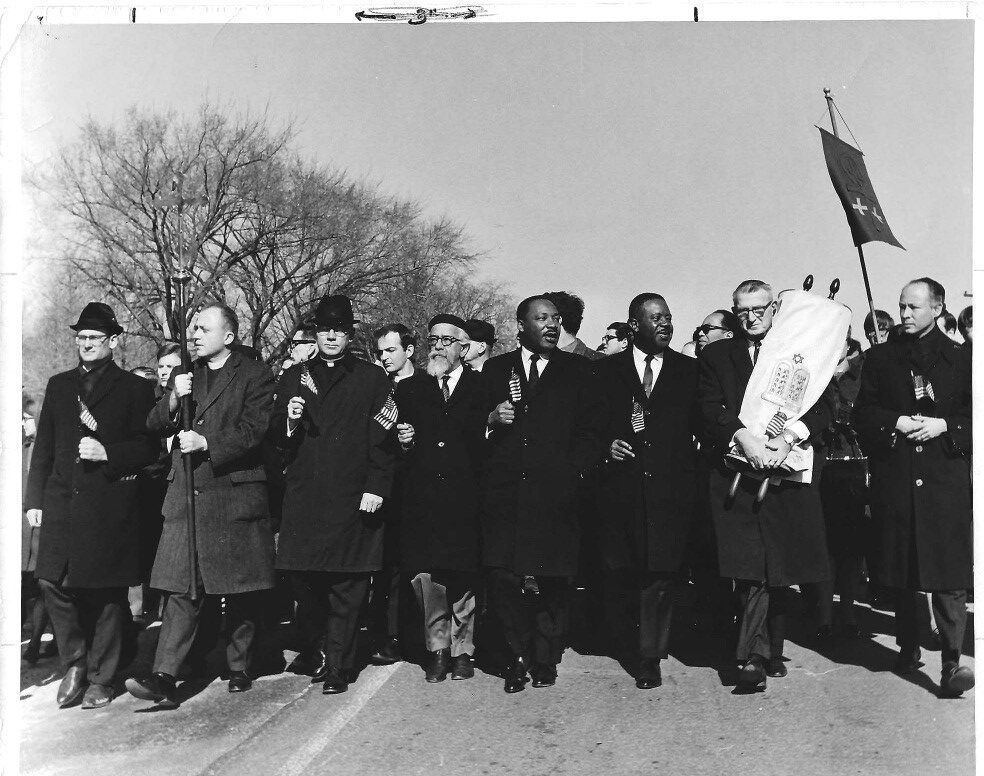
Black and white photo with men marching holding flags and one Torah. Picture includes Martin Luther King, Jr. and Abraham Joshua Heschel.
Courtesy of Peter Geffen

This march, organized by Clergy and Laymen Concerned About Vietnam, took place on February 6, 1968. In addition to Heschel and King who are at the center, others identified in the picture include Ralph Abernathy (next to King), Rabbi Maurice Eisendrath (with Torah), and Rabbi Everett Gendler (far right).
Gallery

  • https://vimeo.com/508269798/605b772908?share=copy

Related Content

He was my spiritual father. Dr. Reuven Kimelman The Prophets "Why We Pray With Our Feet: A Conversation with Cohosts Emelda and Trudy"
Back to God & Humanity

Rabbi Mauricio Balter

Rabbinical models such as Rabbis Heschel and Marshall inspired my decision to become a rabbi—a rabbi who takes part in “political” topics.

Masorti Olami
Israel, born in Uruguay
A Jewish Perspective

I have not met Rabbi Abraham Joshua Heschel personally, but from the moment I joined the Masorti Movement in 1974, I started to connect with his philosophy through his disciple Rabbi Marshall Meyer. During those years, a dictatorial government ruled in Argentina, led by a military junta that killed and tortured thousands of people, while many went missing without explanations. The Military Junta had a clear antisemitic bias. It was in that context that I met Rabbi Abraham Joshua Heschel.

In a society where fear and terror prevailed, very few voices dared to speak up. One of them was that of Rabbi Marshall Meyer, who had been Heschel’s secretary. Immediately after the establishment of the Latin American Rabbinical Seminary, Marshall devoted his time to translating Heschel’s work into Spanish and teaching Heschel’s philosophy in his classes. That is how I grew up, hearing the words of Heschel in the voice of Marshall: his relentless fight for human rights, his struggle against oppression and in favor of interreligious dialogue. He fought at the forefront, fearlessly, to show the Godly presence through his acts in favor of life. Marshall used to say that Heschel was a modern prophet.

Rabbinical models such as Rabbis Heschel and Marshall inspired my decision to become a rabbi—a rabbi who takes part in “political” topics, who fights for ethical behavior by the government and society, who gets involved and commits.

Undoubtedly, Heschel is one of the philosophers who had, and still has, a major influence in my life. What has Heschel’s influence been? First, his perception of man, his vision of the role of man in the world and his bond with God. Heschel said, “The supreme message of the Bible and the prophets of Israel is that God takes man seriously.” And “I think that God seeks man more than man seeks God.”

His famous phrase: “When I marched with Martin Luther King in Selma, Alabama, I felt that my legs prayed,” taught me that prayers could translate into action.

Marshall Meyer said very realistically:

Rabbi Heschel’s whole life was a prayer pronounced with commitment, love, compassion, and a perception of the final sense of history. The Jewish perception of humane, genuine and profound universalism.

Another idea that marked my vision of Judaism that came from Heschel is the notion of sanctifying life:

The image and similarity to God is not enough to grant immortality to man, but to attain sanctity.

Lastly, this paragraph by Heschel that represents how I view our role today:

This is the time to scream. We are ashamed of being human. We are embarrassed to be called religious, when religion has failed to keep alive the image of God in man’s mind. We see what is written on the wall, but we are too illiterate to understand what it means . . . we have imprisoned God in our temples and in our ‘slogans,’ and now the word of God is dying at our lips.

Related Content

It was as if my whole religious world had been challenged, in a good and positive (if earth-shattering) way. Rabbi Gerald Skolnik In The Sabbath, Heschel attempts to reawaken the spirituality and holiness of the Sabbath, and impart the wisdom and gifts it can bring to those who observe the Sabbath. Rebecca Katz Meeting Pope Pius VI
Back to Heschel's Influence

Jane West Walsh, EdD

Rabbi Heschel is quoted as having said we must fight nihilism. He meant it then, and if he were alive today, he would mean it now.

Connecting Cultures for Peace
Baltimore, Maryland
A Jewish Perspective

Rabbi Abraham Joshua Heschel’s legacy is not only his scholarship, but also his leadership as he marched with Dr. Martin Luther King, Jr., and taught us to pray with our feet. I learned from Dr. Susannah Heschel that as she grew up, she was able to watch and learn as those two great men of their age became friends, ate together, prayed together, and spoke out for one another time and time again.  I learned this through my involvement in launching a new nonprofit, Connecting Cultures for Peace. Our founder and president began this organizational journey with a conversation between Dr. Susannah Heschel and Rabbi Capers Funnye (with whom she often presents). We are inspired by and learning from the mid–20th century relationship between Heschel and King. There is so much more to learn about this era and their leadership. 

For me, this is one of the key emotional links to my ability to stay the course today as I seek to address and confront the rising tide of hate speech and violence against Jews, against people of color, against people who are different, against outsiders, against anyone who is not white.  Rabbi Heschel is quoted as having said we must fight nihilism. He meant it then, and if he were alive today, he would mean it now. Connecting Cultures for Peace is an organization of like-minded people who seek out ways to stay the course, fight nihilism, and never give up as the challenges befall us. I believe this is one of Heschel’s greatest gifts to me personally and to all of us who seek support each day as we awake to the frightening news of the day. To this legacy, I am ever grateful. 

Related Content

Most importantly to me, he wasn't afraid to use his talents and unique perspective to push for America to be a better version of itself. Ruth Messinger March on Selma He was my spiritual father. Dr. Reuven Kimelman
Back to Heschel's Influence

Rabbi Jim Rudin

I may not have been an actual classroom student of Heschel's, but I could, and did, stand on his shoulders.  

Interreligious Affairs Director (DATES), American Jewish Committee
Fort Meyers, Florida
A Jewish Perspective

Transcribed from an Interview

I’m very proud that my rabbinical school, Hebrew Union College in Cincinnati, brought Rabbi Heschel to the United States, where he taught for some years. I want to pay tribute to the HUC president at the time, Rabbi Julian Morgenstern, who had the commitment and resources to save Rabbi Heschel’s life.

Rabbi Abraham Joshua Heschel was able to position religious mysticism into an academic context. Prior to that, Jewish academia was largely a world of rationalism, Talmud, and maybe Midrash, but certainly not mysticism. He brought a sense of awe and wonderment into the academic world and also into the mainstream of Jewish religious thought. Part of the reason that he could accomplish this was because of his deeply rooted Jewish learning. He married this sense of wonder with his intellectual rigor. 

I was ordained as a rabbi in 1960. I went into the Air Force military chaplaincy and was stationed in Japan and Korea for two years. When I returned to civilian life, I served in Kansas City for two years as an assistant rabbi. By that time, Rabbi Heschel was becoming nationally and internationally known. 

And of course, in 1963, he gave a now-famous speech at the Conference on Religion and Race in Chicago, where he first met Dr. Martin Luther King, Jr. It was there that Rabbi Heschel said, “At the first conference on religion and race, the main participants were Pharaoh and Moses . . . The outcome of that summit meeting has not come to an end. Pharaoh is not ready to capitulate.” This speech also included the notable statement, “Some are guilty, but all are responsible.” His link to Dr. King was notable; they saw in one another modern-day prophets and charismatic leadership qualities. 

Heschel deeply affected my own professional life: specifically, the role he played at the Second Vatican Council. The Council adopted the Nostra Aetate Declaration in 1965. The Latin means “in our time,” and it fundamentally changed the ways Jews and Catholics interacted with each other. 

A year earlier on September 14, 1964, the day before Yom Kippur, he met with Pope Paul VI in Rome because a proposed version of the Declaration included some troubling conversionary language. Rabbi Heschel pushed the church leader on the issue of conversion, saying,  “As I have repeatedly stated to leading personalities of the Vatican, I am ready to go to Auschwitz any time, if faced with the alternative of conversion or death.”  Heschel made it very clear that the statement’s language on conversion was unacceptable, not only to him, but to the global Jewish community. This language was removed, changing thousands of years of church doctrine.

The next time Heschel impacted me was in 1967. I was one of the first rabbis to travel to Israel after the Six Day War. He had written a superb book about Israel, Israel: An Echo of Eternity, and he expressed for all of us the dread and fear Jews everywhere experienced during the run up to the Six Day War.

After hearing about him since I was a student at HUC-JIR in New York, I first met Rabbi Heschel when he came to the American Jewish Committee headquarters in 1970 or 1971. At that point, he was the Jewish voice of opposition to use of destructive napalm and, indeed, the war in Vietnam, which resonated with me because I had been in Asia when the American military buildup was starting. 

Rabbi Heschel broke out of the narrowness of some parts of the Jewish community. Heschel was in America, doing American things. He was involved with civil rights, whether you agreed with him or not. He was there with MLK in Selma, Alabama. He was also anti–Vietnam War. He was in many public arenas taking personal, religiously inspired stands. 

One of the most important things he did for interreligious work was leaving the JTS building and crossing the street in Morningside Heights in NYC to teach at neighboring Union Theological Seminary. By crossing the street, he built a human bridge. Those connections at Union and his personal meeting with the pope made my work much easier because I could talk about Rabbi Heschel’s extraordinary commitment to interreligious dialogue. This gave me enormous credibility in my work as the director of interreligious affairs at the American Jewish Committee. I may not have been an actual classroom student of Heschel’s, but I could, and did, stand on his shoulders.  

Related Content

He lives on in me in my social and interfaith activism, as I expect our partners to stand by us as we stand by them. Rabbi Susan Grossman God in Search of Man Heschel’s confidence in the power of the tradition was a constant example throughout his life. Rabbi David Wolpe
Back to God & Humanity

Rabbi Michael Marmur, PhD

Had it not been for him, I would have done less, cared less, thought less, lived less.

Associate Professor of Jewish Theology, Hebrew Union College-Jewish Institute of Religion
Jerusalem, Israel
A Jewish Perspective

I never met Abraham Joshua Heschel. I was a 10-year old Londoner when he died. Nonetheless, he has been a presence in my life for as long as I can recall. He lived on my father’s bookshelves, where the mysterious paradox inherent in such titles as God In Search of Man and Who Is Man? caught my young attention. He came alive when his aphorisms, more evocative than abstract reasoning or unbridled polemic, were quoted in sermons and conversations.

As a young rabbi casting around for a doctoral research topic, my initial idea had been to compare aspects of the thought of Heschel and Mordecai Kaplan. I was guided by the instinct that Israel (where I had moved) needed to undergo significant processes both of Kaplanization and of Heschelization, and I wanted to help think this through. When I decided that acquiring expertise in the work of both of these giants of 20th-century Judaism was overly ambitious, it was clear to me with whom I preferred to spend the time I would dedicate to this research. 

I was in the library of the University of Haifa, rereading God In Search of Man slowly and carefully, when my particular link to Heschel was forged. I noticed that appended to almost every chapter were intriguingly extensive and suggestive endnotes. What was their purpose and to whom were they directed? This question—and the questions it in turn triggered—have preoccupied me for the past 30 years. 

It may seem odd to have developed such an interest in an aspect of Heschel’s work that is so literally marginal. Most of those who have been drawn into Heschel’s magnetic field have been attracted by his spirituality or his activism or his language. Drawn to all these as I surely was and still am, it was in fact his footnotes that captivated me. I was intrigued by the way in which Heschel based his challenging theology not in the dictates of Kantian philosophy (which he respected) or Freudian psychology (which he respected less), but from within the rich and varied sources of Judaism. He turned to these sources not as literary embellishments, but as urgent and vibrant expressions. The great Jewish philosopher Hermann Cohen had sought to make the case for a Religion of Reason Out of the Sources of Judaism, but here was an approach to Judaism and to life that was not just derived from Jewish sources—it was marinated in them, immersed and informed by profound learning. I was hooked. 

Since then, following Heschel’s writings has provided a more rigorous syllabus than any I have encountered in a seminary or university. That which Heschel had committed to memory at a young age, I have intended to chase up and track down. He has not only been the primary object of my research, he has also been my teacher. 

It is certainly the case the Abraham Joshua Heschel was a very learned Jew. This places him in select company, but he was not unique in his erudition. It was the combination of deep learning with his commitment to action, his unwillingness to stay ensconced in his study room, his engagement with the great questions of his day that set him apart. I hear Heschel’s voice every time I am tempted to settle for vapid progressive slogans, and every time I am tempted to stay in my comfort zone when I should be protesting. His particular form of praxis, the welding together of doing and learning, has been my principle guide. 

One of the hundreds of works I would never have encountered were it not for Heschel is entitled To’ameha Chayyim Zachu. This expression has its roots in the additional Sabbath prayer, and it relates to the Sabbath itself. Those who taste and experience it are privileged with life. As I consider decades of reading, thinking, and responding to Heschel, it is this expression that comes most readily to mind. To taste Heschel, his remarkable combination of learning and activism, his call to wonder and response, his critique and his poetry, his hints and his slogans, his certainties and his vulnerability, his intellect and his soul is a dose of life. Had it not been for him, I would have done less, cared less, thought less, lived less. 

I am surely not alone. Fifty years after he breathed his last, Abraham Joshua Heschel continues to offer a taste of life for contexts and generations he could not have imagined. So long as he is quoted (and misquoted), so long as his example serves as inspiration, he has not breathed his last. 

Reading through the Heschel papers at Duke University some years ago, I shed a tear. I had just come across a page (there are many of them to be found there) upon which Heschel had written out a teaching. This one is from Rabbi Nachman of Breslov. To paraphrase, "When a student repeats the teaching of a tanna, a foundational sage, there is a kind of embrace between the tradition and the tradent, the propagator and the broadcaster. You kiss the tanna, and the tanna kisses you. I never met Abraham Joshua Heschel. But I sense his embrace." 

His memory is for a blessing, and those who experience it are privileged with the gift of life.  

Gallery

Related Content

Here is this thinker whose words shaped the essence of how I think about Judaism. Rabbi Pamela Barmash, PhD He was open to being changed by others. Rabbi Daniel Nevins Rabbi Elliot Cosgrove 50th Yahrzeit Sermon
Back to God & Humanity

Dr. Harold Kasimow

He remains the most important spiritual teacher of my life.

Emeritus Professor, Grinnell College
Grinnell, Iowa
A Jewish Perspective

I was a student at JTS from 1956 to 1961.  In 1957 I took two courses with Professor Heschel: one on Genesis with an emphasis on Rashi’s interpretation and one on Jewish theology in which we read Heschel’s book God in Search of Man. In 1971, when I was a graduate student at Temple University, in preparation for my dissertation on Heschel, I traveled from Philadelphia to New York City once a week to attend a seminar that Heschel was teaching to his rabbinical students on his book Torah min Hashmayim. After every class I went to his office where Heschel gave me many sources for my thesis. When he left, I walked him home. Sometimes we would converse in Yiddish, our common birth language. 

I was very challenged by the statement that “Providence may someday create a situation which would place us between the river Jordan and the river Ganges,” from his book God in Search of Man. To me, this statement seemed to mean that Professor Heschel was encouraging dialogue between Jews and members of Asian religions. So I devoted a great deal of time to the study of Asian religions. I was even more challenged by his essay “No Religion Is an Island,” where he argues that no religion has a monopoly on truth or holiness and says “In this eon, diversity of religions is the will of God.” In my books on Heschel, I have devoted a great deal of time to his vision of other faiths.

Heschel, who devoted his life to love and peace, was for me not just a superlative teacher but my interreligious hero. He remains the most important spiritual teacher of my life. At Grinnell College, I have offered a seminar: Abraham Joshua Heschel: A Jewish Saint of the 20th Century. Here are just a few of his ideas that I think may have been very moving for students at Grinnell, most of whom were not Jewish:

1.  Human responsibility rather than divine responsibility. Heschel said “few are guilty but all are responsible.” I devote a great deal of time to this issue, especially when we read Simon Wiesenthal’s The Sunflower, to which Heschel contributed a response.

2.  Heschel always looked for harmony and the positive. Heschel said “just to be is a blessing, just to live is holy.” Very often, I showed the interview that he had with Carl Stern just before he died. The interview ended with Heschel’s message to young people: “Remember that there is meaning beyond absurdity. Know that every deed counts, that every word is power . . . Above all, remember that you must build your life as if it were a work of art.” I think this was a very powerful message for my young students.

3. His stress on wonder and radical amazement. Heschel said, “Our goal should be to live life in radical amazement . . . Get up in the morning and look at the world in a way that takes nothing for granted. Everything is phenomenal; everything is incredible; never treat life casually. To be spiritual is to be amazed.” He also said “I have one talent, and that is the capacity to be tremendously surprised, surprised at life, at ideas. This is to me the supreme Hasidic imperative: Don’t be old. Don’t be stale.”

4. His engagement with the Civil Rights Movement and his stress on social justice.

Heschel may be best known for his 1965 Selma to Montgomery march with Martin Luther King, Jr. After the march he wrote, “I felt my legs were praying.” He was also an early activist against the war in Vietnam and in the plight of the Jews in the Soviet Union.

I focus on his great contribution to interreligious dialogue and on his original idea of pathos. I always remember to tell my students what Heschel once wrote (or perhaps just said in class), that if he could teach only one central idea from Judaism, it would be, "And God said I will make man in my image after my likeness, and God created man in his own image, in the image of God He created him; male and female, He created them."

Additional Text:

Interfaith Affinity: The Shared Vision of Rabbi Heschel and Pope Francis

Related Content

He shot an arrow into thinking about religion; it wasn’t just about don’t do this, do that, but instead make yourself open to the amazement of the world. Rabbi Michael Graetz Heschel with ABC's Frank Reynolds We, his readers, Jewish and Christian, stood in wonder before it – not before him, but before his ability to “walk with God.” Rabbi David R. Blumenthal, PhD
Back to God & Humanity

Rabbi Jill Jacobs

He offered me an urgency that I hadn't felt in my Judaism before then.

T’ruah: The Rabbinic Call for Human Rights
New York, New York
A Jewish Perspective

Transcribed from an Interview

I first encountered Heschel at Prozdor at Hebrew College in Boston when I was in high school. In Bible class, The Prophets was one of our textbooks. This book wasn’t presented as a treatise from a philosopher who speaks about justice. I remember going through it and being intrigued; I didn’t understand 99 percent of it, but it stuck in my head. At some point in college and rabbinical school, I reread The Prophets, found God in Search of Man and then Moral Grandeur. Then in a class with Neil Gillman (z”l) in my first year of rabbinical school, we spent quite a lot of time with Heschel.

In The Rabbinical School, I was developing an ambition of doing social justice as a rabbi, which was not a thing that people were talking about in the late 1990s, early 2000s. Now it’s completely and totally normal. But at JTS at the time, the response was, “Why don’t you go to law school, social work school, or something else?” When I read Moral Grandeur the first time, it felt like he had said all of the things. Not only did somebody already write what I’ve been looking for, he wrote it better than I could even imagine. 

He offered me an urgency that I hadn’t felt in my Judaism before then. I didn’t have models for how Judaism interacted with engagement in the world and with justice work. I grew up in a Conservative congregation and we went to a soup kitchen every Christmas, but social justice wasn’t really built into what we were doing. And it certainly hadn’t been put in theological or Jewish language besides tzedakah, nothing deeper than that. This was extraordinary. 

Through books like The Prophets and God in Search of Man, Heschel provided me with the sense that God cares about what's happening here and that what we're doing has an impact on God. For me, Heschel put together that observance and social justice are connected. It is all unified because God cares about what we do. He provided a model of an observant person with a relationship with God, deeply immersed in text, for whom social justice is part of his daily life.

I don’t go to protests on Shabbat. I work six days a week. Shabbat is important to me; it is a check on our hubris. There is a sense that I must work 24 hours a day, because there is an emergency. But the truth is, there is always an emergency. And it’s been an emergency since the world was created. I can check out of my activism for 25 hours each week. God created the world in six days, but the world wasn’t finished. Even if I work that one extra day, there wouldn’t be less work to do the next day.

I aspire to Heschel’s integration between his life as a traditionally religious Jew with a relationship with God and his deep involvement in justice work. There is no division; it is all part of a whole. I see Judaism as an integrated way of living that doesn’t make divisions between my activism and religious practice. 

Additional Text:

Stop Looking for the Next Heschel. They Are All Around You (The Forward)

Related Content

Commitment to the divine imperative . . . empathy with the divine pathos. Rabbi Lenny Levin His presentation of the unique Jewish foundation of the 'cathedral in time.' Michal Govrin What inspired me most is Heschel's involvement in Jewish-Christian dialogue. Dr. Stanislaw Obirek
Back to God & Humanity

Rabbi Susan Grossman

He lives on in me in my social and interfaith activism, as I expect our partners to stand by us as we stand by them.

Beth Shalom Congregation
Columbia, Maryland
A Jewish Perspective

Where did you first encounter Heschel’s work?
When I began to be observant, I was inspired by Heschel’s The Sabbath. Inspired by his walking out of JTS one day to pray with his feet, marching with Rev. King, I established an annual interfaith MLK-AJH Shabbat in 1998 and built a strong social action program in my congregation and community. His approach to Matan / Kabbalah Torah and The Prophets inspired my commitment to the evolution of Jewish law, practice, and justice as a reflection of our evolving understanding of Kabbalat Torah in my work on the Committee for Jewish Laws and Standards (CJLS), in social action, and in my Jewish feminist writings and lecturing.

How did Heschel and his thinking inspire your work, religious life, or civic engagement?
Heschel inspired me in all aspects of my rabbinate, from my civic engagement to my personal theology and religious life, to my teaching. 

In civic engagement, his model inspired me not only to be active in justice issues but to build strong interfaith coalitions that worked together on issues of mutual concern for the Black, Muslim, East Asian, and Jewish communities. This coalition began early in my rabbinate in Westchester as I established the first interfaith black/Jewish Martin Luther King / Abraham Joshua Heschel Sabbath there during MLK weekend in lower Westchester in 1990. I initiated a similar program in Howard County, Maryland, beginning in 1998, that grew into a celebrated part of the Howard County Martin Luther King Weekend Holiday Commemoration, included an interfaith choir, and was attended by most elected and appointed officials, interfaith leaders, congregants of participating houses of worship, neighbors, and friends. This annual event, held in partnership with Black churches and held at my synagogue, Beth Shalom of Columbia, Maryland, laid the foundation for deeper interfaith relationship-building and transitioned to our award-winning Howard County Courageous Conversations, of which I was a founding clergy member with the leading Black minister in town, Rev. Turner, and in cooperation with the late great acolyte of Rev. King, Congressman Elijah Cummings.

I see myself as a Heschelian theologian, building upon his distinction between Matan Torah and Kabbalat Torah as a religious Jewish feminist and in my approach to halakhic development and change, as reflected in my teshuvot (responses) and other work for the CJLS.

What of Heschel lives in you?
Heschel lives on in me as I teach his story to my students of all ages, when we discuss the Holocaust, when we discuss where God is, and as we explore how to live the Sabbath as a temple of time. He lives on in me in my beliefs and my social and interfaith activism, as I expect our partners to stand by us as we stand by them. And he lives on in me, seeking to experience the wonder of creation each day.

Additional Text

Opening Remarks, Twentieth Anniversary, MLK-Heschel Shabbat

The Gates of Prayer Are Always Open

Related Content

How could one ever top an invitation from a brilliant scholar, my most unforgettable professor? Rabbi Moshe Pomerantz  Rabbinical models such as Rabbis Heschel and Marshall inspired my decision to become a rabbi—a rabbi who takes part in “political” topics. Rabbi Mauricio Balter Shabbat went from something I did to somewhere I dwelled Rabbi Elyse Winick
Back to Heschel's Influence

Rabbi Jim Lebeau

I have no doubt that my involvement in these same causes were because of his influence upon me.

Rabbinical Assembly
Israel
A Jewish Perspective

Where did you first encounter Heschel’s work?

As a student in The Rabbinical School in the late 1960s.

How did Heschel and his thinking inspire your work, religious life, or civic engagement?

I was deeply inspired by the model of social activism that Rabbi Heschel brought to the JTS community. It helped that his views echoed my views. My wife and I were involved in anti–Vietnam war efforts, as was Rabbi Heschel. As I entered JTS, I knew that all graduating rabbis were obligated to serve as US military chaplains. Before my graduation, JTS canceled this obligation because of opposition to the war.  I met with Rabbi Heschel, and he encouraged me to honor my commitment to the chaplaincy. His view was that Jewish military personnel needed rabbis. Following his advice, I served for two years as a US Navy Chaplain with the Marine Corps and realized how necessary and valuable was my time with the Jewish members of my military community.

What of Heschel lives in you?

I honor Rabbi Heschel’s involvement with the non-Jewish community and his support for civil rights and the cause of Soviet Jewry, just to mention a few of his righteous acts. I have no doubt that my involvement in these same causes throughout my career were because of his influence upon me.

Related Content

Heschel's life was a life of prophetic agitation in which he saw his role as pushing the Jewish community beyond their comfort zones. Rabbi Aryeh Cohen JTS Memorial Service for Martin Luther King Jr Here is this thinker whose words shaped the essence of how I think about Judaism. Rabbi Pamela Barmash, PhD
Back to Heschel's Influence

Rabbi Jack Moline

If I wanted to be credible in my work toward societal justice, then it was essential that I make him one of my mentors.

Interfaith Alliance
Virginia
A Jewish Perspective

Where did you first encounter Heschel’s work?

I first encoutered Heschel in United Synagogue Youth.

How did Heschel and his thinking inspire your work, religious life, or civic engagement?

Heschel’s activism in the Civil Rights Movement, especially his presence in Selma, Alabama, was a powerful example to me. I wish I could say it motivated me directly to my engagement in interfaith and civil rights causes, but more accurately it was his impact on the non-Jews that I encountered in my rabbinate that inspired me to be that kind of rabbi. The activists I encountered always wanted to know if I knew him, did I hear him speak, did he influence me. If I wanted to be credible in my work toward societal justice, then it was essential that—across a generation and the gap between our adult lives—I had to make him one of my mentors. When I had the privilege of marching across the Edmund Pettus Bridge with John Lewis, many years later, I felt like my legs were in Heschel's minyan.

Additional Texts:

Cosmic Outrage

A Life to Emulate

Playing Dice with the Universe—Leviticus 8:8

Comfort, Comfort

This Is Not a Sermon

Related Content

He imbued in us a sense of wonder and a commitment to justice. Lapidus & Myles This framework - inspired by Heschel's radical amazement with the world in its entirety - is most likely why I became the person I am today. Sofia Freudenstein "The Spirit of the Prophet" Song