heschel

Back to God & Humanity

Israel: An Echo of Eternity
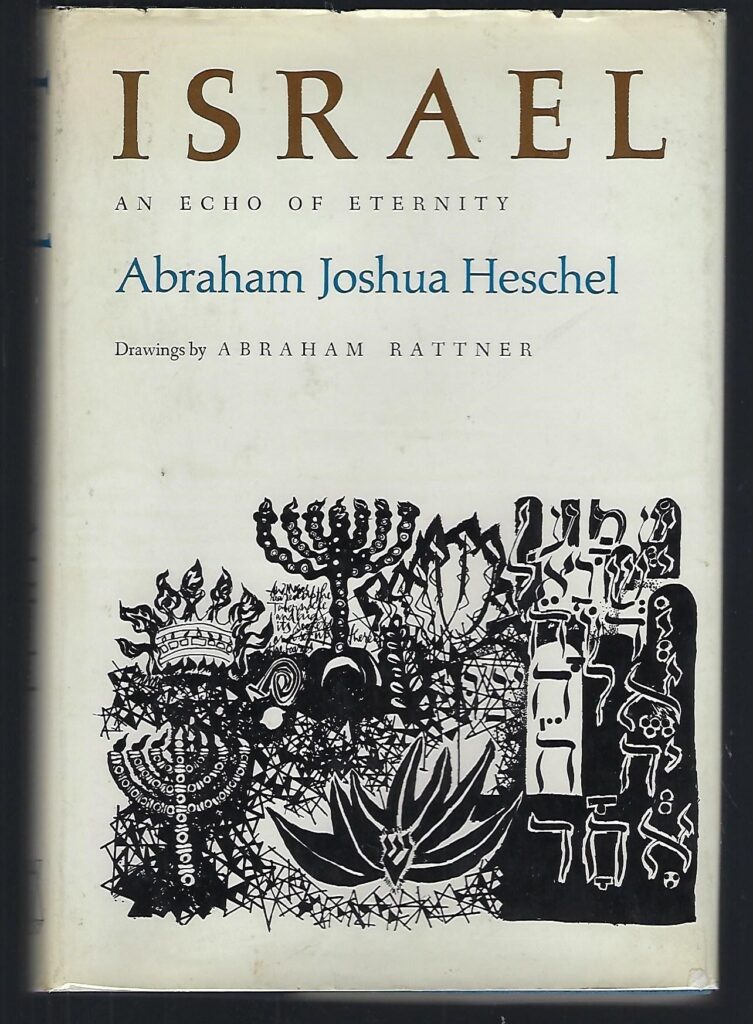
Book Cover-Israel: An Echo of Eternity with wood cut menorah and Hebrew letters

Israel: An Echo of Eternity (1969)

Focused on the significance of the Jewish people, this book explores the historical and spiritual dimensions of Jewish identity. Heschel reflects on the enduring covenant between God and the Jewish people, emphasizing the responsibility to live in accordance with divine teachings. Heschel wrote this book following the Six Day War.

Related Content

Castle in Time Orchestra, "Prophets" I may not have been an actual classroom student of Heschel's, but I could, and did, stand on his shoulders.   Rabbi Jim Rudin I value Heschel's teaching that we are not all prophets but there should be something of the prophet in every one of us. Dr. Arnold Eisen
Back to God & Humanity

Man Is Not Alone

Book Cover-Man is not Alone, golden dust jacket with image of Michaelango's Adam

Man Is Not Alone: A Philosophy of Religion (1951):

In this philosophical exploration, Heschel delves into the nature of religious experience and the relationship between humanity and God. He emphasizes the idea that true knowledge of God comes through a profound sense of awe and wonder.

Additional Content:

Heschel in Ottawa 1967, Exploring Man Is Not Alone

Related Content

He lives on in me in my social and interfaith activism, as I expect our partners to stand by us as we stand by them. Rabbi Susan Grossman Had it not been for him, I would have done less, cared less, thought less, lived less. Rabbi Michael Marmur, PhD In The Sabbath, Heschel attempts to reawaken the spirituality and holiness of the Sabbath, and impart the wisdom and gifts it can bring to those who observe the Sabbath. Rebecca Katz
Back to God & Humanity

Man’s Quest for God

Book Cover-Man's Quest for God, with brown blocks
Book Cover-Man's Quest for God with rainbow

Man’s Quest for God: Studies in Prayer and Symbolism (1954):

In this book, Heschel explores the profound aspects of prayer and religious symbolism. He delves into the human quest for a meaningful connection with the divine, examining the role of prayer as a spiritual discipline and the symbols that facilitate this dialogue.

Related Content

Commitment to the divine imperative . . . empathy with the divine pathos. Rabbi Lenny Levin Whatever the yearning is that throbs within us—whether or not we call it the Holy Spirit—it is our responsibility to make it live. Edward K. Kaplan Most importantly to me, he wasn't afraid to use his talents and unique perspective to push for America to be a better version of itself. Ruth Messinger
Back to God & Humanity

God in Search of Man

God in Search of Man: A Philosophy of Judaism (1955):

This book examines the dynamics of the human-divine relationship. Heschel explores the ways in which individuals can encounter God through prayer, ethical living, and religious commitment.

Related Content

The idea of revelation as a partnership to which both God and the people Israel make a contribution is at the core of Heschel's theology. Dr. Benjamin Sommer He shot an arrow into thinking about religion; it wasn’t just about don’t do this, do that, but instead make yourself open to the amazement of the world. Rabbi Michael Graetz March on Selma
Back to Justice

The Prophets

Book Cover-The Prophets, two colors red and gold

The Prophets (1962):

Heschel offers a comprehensive study of the Hebrew prophets in this influential work. He highlights the prophetic call to social justice and ethical behavior, emphasizing the prophets’ role in challenging injustice and promoting a deeper understanding of God’s will. This work was adapted from his dissertation Das prophetische Bewuβstein (Prophetic Consciousness).

Related Content

He imbued in us a sense of wonder and a commitment to justice. Lapidus & Myles I may not have been an actual classroom student of Heschel's, but I could, and did, stand on his shoulders.   Rabbi Jim Rudin Protest can be a form of prayer, heard both in the rhythm of the psalms and soles on pavement. Reverend Jamie Washam, PhD
Back to Justice

Who Is Man?

Book Cover-Who is Man

Who Is Man? (1965)

Heschel reflects on the nature of humanity and the purpose of existence in this philosophical work. He discusses the unique qualities that distinguish humans from other beings and explores the ethical responsibilities that come with human existence.

Related Content

The Eternal Light Interview with Carl Stern The encounter vividly encompasses for me Heschel's remarkable qualities . . . not only his warmth, caring, humor, and humanity, but his insistence on rigorous and careful scholarship.  Rabbi Eli Schochet Moral Grandeur and Spiritual Audacity
Back to Justice

Moral Grandeur and Spiritual Audacity

Book Cover-Moral Grandeur and Spiritual Audacity, with bright image of trees

Moral Grandeur and Spiritual Audacity: Essays (1996)

This collection of essays, compiled and edited by Heschel’s daughter Dr. Susannah Heschel, touches on Heschel’s moral and spiritual reflections on various topics, such as social justice, ethical responsibility, and the moral challenges of the modern world. Heschel’s impassioned voice encourages readers to embrace moral grandeur and spiritual audacity in their lives.

Related Content

Rabbi Heschel is quoted as having said we must fight nihilism. He meant it then, and if he were alive today, he would mean it now. Jane West Walsh, EdD I may not have been an actual classroom student of Heschel's, but I could, and did, stand on his shoulders.   Rabbi Jim Rudin His presentation of the unique Jewish foundation of the 'cathedral in time.' Michal Govrin
Back to Prayer

Heavenly Torah

Heavenly Torah: As Refracted Through the Generations (2005)

This work is a translation (with commentary for the reader) of Heschel’s three-volume work in Hebrew on the different theologies (Torah Min Hashamayim) of the Rabbis of the Talmudic period and how those theologies lived on and confronted one another in later periods. The first two volumes of the original work were published in 1962 and 1965, respectively. The third Hebrew volume was published posthumously in 1990. The English translation by Rabbi Gordon Tucker was published in 2005.

Related Content

King and Heschel at the Rabbinical Assembly Conference "Praying with Our Feet" Lapidus & Myles The Sabbath