God & Humanity

Back to God & Humanity

“Divine Pathos” Sermon

Sermon delivered by Rev. Dr. Colin Bossen delivered as part of a series on “The Lives of the Spirit.” The civil rights activist and Jewish theologian Abraham Joshua Heschel understood God as pathos. He explores Heschel’s belief that religious piety and social justice activism, which he named the prophetic, were inextricably linked. 
Related Content

Heschel with Fritz Rothschild The first Jewish text included on our syllabus was a chapter from Heschel’s God in Search of Man, and I was entranced by it. Rabbi Geoffrey Claussen, PhD Heschel’s emphasis on the need for “text-people,” prompted me to know that his life of learning, inspiration, and activism was Torah. Rabbi Elie Spitz
Back to God & Humanity

Spiritual Audacity: The Abraham Joshua Heschel Story

Documentarian Martin Doblemeier’s film which explores Heschel’s activism. The site includes clips and educational materials on themes relating to Heschel’s justice work, his theology, and his interfaith dialogue.

God in Search of Man

The Prophets

Repairing the World

No Religion is an Island

Heschel and the Vietnam War

Heschel and Jewish Tradition

The Sabbath

Related Content

In my previous religious life, praying for me was about technique, but without intention. Heschel changed my attitude in prayer. Sefi Dahan But for that which is more real than the material world, Heschel showed me the path on which to walk. Dr. Peter Saulson Rabbi Heschel is quoted as having said we must fight nihilism. He meant it then, and if he were alive today, he would mean it now. Jane West Walsh, EdD
Back to God & Humanity

Heschel in Ottawa, 1968 or 1969, Exploring “Shabbat as Spiritual Sanctuary”

Link to JTS Library

Edward K. Kaplan Research Collection on Abraham Joshua Heschel, The Library of the Jewish Theological Seminary, New York, New York, ARC.2021.07.000, (Box 27:105). Digitization and cataloging funded by a grant from the National Historical Publications and Records Commission (NHPRC).

Annotation

Side A. Opening remarks (01:40min.) — Introducing Abraham Joshua Heschel (04:32 min.) — Lecture / Abraham Joshua Heschel (32:29) — Side B. Lecture [continued] / Abraham Joshua Heschel (21:33 min.) — Questions (01:33 min.) — Thanking Professor Heschel / Hugo Leventhal (03:24 min.) — Closing remarks (03:22 min.)

Related Content

"Why We Pray With Our Feet: A Conversation with Cohosts Emelda and Trudy" He was open to being changed by others. Rabbi Daniel Nevins Rabbi Heschel taught the Bible and linked it to our present time with effortless elegance.  Reverend Johnnie Moore
Back to God & Humanity

The Eternal Light Interview with Carl Stern

An excerpt from The Eternal Light, a documentary by Diva Communications.

Journalist Carl Stern discusses the long term impact of this interview.

Related Content

He remains the most important spiritual teacher of my life. Dr. Harold Kasimow Every Word Has Power: The Poetry of Rabbi Abraham Joshua Heschel I was inspired by the Jewish concept of working for social change. Orly Erez Likhovski
Back to God & Humanity

Heschel with ABC’s Frank Reynolds

Originally broadcast on the television program Directions on ABC on November 21, 1971. The conversation was about faith and spirituality in the modern world.

Related Content

Heschel in Ottawa, 1968 or 1969, Exploring "Shabbat as Spiritual Sanctuary" It was my own encounter with Heschel’s writings as an adolescent and young adult that challenged me. Rabbi Simkha Weintraub Rabbi Elliot Cosgrove 50th Yahrzeit Sermon
Back to God & Humanity

Commemorative Issue of Conservative Judaism

The Fall 1973 edition of Conservative Judaism was dedicated to the legacy of Abraham Joshua Heschel. The issue included articles by Arthur Green, Louis Finkelstein, Edward K. Kaplan, Judith Hershlag Muffs, and Fritz Rothschild, among others.

Related Content

Justice is the balance between created and creator! Itay Seith We, his readers, Jewish and Christian, stood in wonder before it – not before him, but before his ability to “walk with God.” Rabbi David R. Blumenthal, PhD Moral Grandeur and Spiritual Audacity
Back to God & Humanity

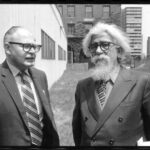
Heschel with Fritz Rothschild

A student and colleague of Heschel’s, Fritz Alexander Rothschild (b. October 4, 1919; d. March 7, 2009) was the Joseph J. and Dora Abbell Professor of Philosophy at The Jewish Theological Seminary. Rothschild wrote Between God and Man: An Interpretation of Judaism, the first introduction to the thought and writings of Abraham Joshua Heschel.

He like Heschel was born in Europe and fled before the war. Rothschild escaped to Rhodesia (present day Zimbabwe) in 1938 and came to the United States in 1948. He was ordained at JTS in 1955 and received his doctorate under Heschel’s supervision in 1968. He was a longtime member of the JTS faculty.

Related Content

Israel: An Echo of Eternity This framework - inspired by Heschel's radical amazement with the world in its entirety - is most likely why I became the person I am today. Sofia Freudenstein God in Search of Man. . .touched my heart and soul. Reverend Paul E Capetz
Back to God & Humanity

Rabbi Mauricio Balter

Rabbinical models such as Rabbis Heschel and Marshall inspired my decision to become a rabbi—a rabbi who takes part in “political” topics.

Masorti Olami
Israel, born in Uruguay
A Jewish Perspective

I have not met Rabbi Abraham Joshua Heschel personally, but from the moment I joined the Masorti Movement in 1974, I started to connect with his philosophy through his disciple Rabbi Marshall Meyer. During those years, a dictatorial government ruled in Argentina, led by a military junta that killed and tortured thousands of people, while many went missing without explanations. The Military Junta had a clear antisemitic bias. It was in that context that I met Rabbi Abraham Joshua Heschel.

In a society where fear and terror prevailed, very few voices dared to speak up. One of them was that of Rabbi Marshall Meyer, who had been Heschel’s secretary. Immediately after the establishment of the Latin American Rabbinical Seminary, Marshall devoted his time to translating Heschel’s work into Spanish and teaching Heschel’s philosophy in his classes. That is how I grew up, hearing the words of Heschel in the voice of Marshall: his relentless fight for human rights, his struggle against oppression and in favor of interreligious dialogue. He fought at the forefront, fearlessly, to show the Godly presence through his acts in favor of life. Marshall used to say that Heschel was a modern prophet.

Rabbinical models such as Rabbis Heschel and Marshall inspired my decision to become a rabbi—a rabbi who takes part in “political” topics, who fights for ethical behavior by the government and society, who gets involved and commits.

Undoubtedly, Heschel is one of the philosophers who had, and still has, a major influence in my life. What has Heschel’s influence been? First, his perception of man, his vision of the role of man in the world and his bond with God. Heschel said, “The supreme message of the Bible and the prophets of Israel is that God takes man seriously.” And “I think that God seeks man more than man seeks God.”

His famous phrase: “When I marched with Martin Luther King in Selma, Alabama, I felt that my legs prayed,” taught me that prayers could translate into action.

Marshall Meyer said very realistically:

Rabbi Heschel’s whole life was a prayer pronounced with commitment, love, compassion, and a perception of the final sense of history. The Jewish perception of humane, genuine and profound universalism.

Another idea that marked my vision of Judaism that came from Heschel is the notion of sanctifying life:

The image and similarity to God is not enough to grant immortality to man, but to attain sanctity.

Lastly, this paragraph by Heschel that represents how I view our role today:

This is the time to scream. We are ashamed of being human. We are embarrassed to be called religious, when religion has failed to keep alive the image of God in man’s mind. We see what is written on the wall, but we are too illiterate to understand what it means . . . we have imprisoned God in our temples and in our ‘slogans,’ and now the word of God is dying at our lips.

Related Content

Rabbi Heschel is quoted as having said we must fight nihilism. He meant it then, and if he were alive today, he would mean it now. Jane West Walsh, EdD He offered me an urgency that I hadn't felt in my Judaism before then. Rabbi Jill Jacobs Rabbi Heschel taught the Bible and linked it to our present time with effortless elegance.  Reverend Johnnie Moore
Back to God & Humanity

Rabbi Martin Cohen, PhD

That book [The Prophets]—almost more than any other—set me on the course that eventually became my life. 

Shelter Rock Jewish Center
Roslyn, New York
A Jewish Perspective

I never met Professor Heschel in person. In fact, we just missed each other: he died in the winter of 1972 and I only began my studies at JTS in the fall of 1974. But even so I can say that he was responsible both for my choice of JTS for rabbinical school and for my choice of the rabbinate, and particularly the congregational rabbinate, as my life’s profession.

As I moved closer to organized Jewish life and to Jewish observance, I was all over the map: I worked at one of the UAHC summer camps and taught in a Reform Religious School, but on Shabbat I davened in an super-traditional shtibl. I wore a tallis koton under my shirt, but walked around bareheaded in the street. In a strange inversion of my parents’ custom, I kept strictly kosher only outside of the house. I owned a pair of bar-mitzvah tefillin (the purchase was, as I recall, requisite), but I had no idea how to adjust the head strap to make it fit my grownup-sized head. My rabbinic models were both Conservative rabbis: Rabbi Max Arzt and Rabbi Ben Zion Bokser, both now of blessed memory. But I was still smarting from being refused admission to the Hebrew high school in the synagogue I thought of as my own because my parents weren’t actually members, just non-members who sent me to Hebrew school there, made my bar mitzvah there, and paid a fortune for non-member seats on the High Holidays. So I was the embodiment of the wandering Jew: at home everywhere and nowhere.

And then I discovered Heschel and things began to clarify. First, I came across God in Search of Man in a second-hand bookshop in North Adams, Massachusetts. I was confused (there were whole chapters I didn’t understand at all), but also intrigued. A few months later, I noticed a copy of Man’s Quest for God in, of all places, my barbershop on Queens Blvd. in Forest Hills. When I asked the barber why it was there among all the magazines, he told me that someone had left it there and not returned for it. I was free to take it if I wished. I did take it, and I read it through in a day or two. I had no idea at the time, but in retrospect I see myself being drawn forward in a specific direction. And then, in the fall of my sophomore year in college, I bought a copy of The Prophets, published for some reason in those days in two volumes. I was still reading the first volume when I saw in the paper one morning that its author had died the day before.

I didn’t attend the funeral. Why would I have? But Heschel’s death only made it seem more urgent that I read even more intently; since I was obviously not going to meet the man in person, all I could do was try to know the author through his work. Reading that book, Heschel’s The Prophets, was transformational for me. I had just begun to understand how the Tanakh was put together, which books went where, which were the earlier works and which the later. I was at the very beginning of my studies, and in every imaginable way. But here was a work that showed me—not told me or suggested to me, but showed me graphically and profoundly—just what it could mean to live a life immersed in the literary heritage of Israel. Heschel seemed to know these people—these ancient prophets whose words he appeared not only to know inside-out, but to be able to look through into the souls of their speakers. He wrote about Isaiah, about Amos, especially about Jeremiah (I thought) as though he knew them. Or, even more amazingly, as though he knew them intimately, as though he and they were—impossibly—friends.

More to the point was the God-talk in that book: Heschel was able to paint a portrait (an aniconic one, of course) of God using the chapters of the prophets’ visions and oracles as his paintbox. It wasn’t only God’s prophets that he appeared to know as contemporaries and intimates; it was the God they served whom Heschel seemed to know personally. And that concept of Friend God, as opposed to Judge God or Sovereign God, appealed mightily to me. I read the second volume (much more difficult, I thought, than the first). Then I read both books a second time. Eventually, I set them aside: I was a college sophomore and was drowning in my “real” reading assignments. Reading Heschel and, particularly, The Prophets, seemed to me at the time mere happenstance. But when I think about things after all these many years, I can see that some seed had been planted, that some germ of an idea had taken root somehow deep within. It took a while for that idea to make itself fully manifest to me (how that happened would be a different story), but that book—almost more than any other—set me on the course that eventually became my life. 

Related Content

But for that which is more real than the material world, Heschel showed me the path on which to walk. Dr. Peter Saulson An invitation to Sabbath keeping that was at once thoroughly Jewish but also universally available—and more than that, necessary for our survival. Rev. Wil Gafney, PhD Prayer is a serious and consequential matter. There is a tension between the fixed and the spontaneous prayers, which must be felt. Rabbi Rolando Matalon
Back to God & Humanity

Rabbi Elie Spitz

Heschel’s emphasis on the need for “text-people,” prompted me to know that his life of learning, inspiration, and activism was Torah.

Man smiling in a suit

Congregation B’nai Israel
Tustin, California
A Jewish Perspective

When I was 11 years old, Professor Heschel came to my congregation in Phoenix, Arizona, to dedicate our new sanctuary. Completion of the building was a moment of great anticipation for my community. And I, who attended Shabbat services each Saturday with my father, knew that for Rabbi Moshe Tutnauer, sharing this moment with his teacher mattered to him greatly. I do not remember what Rabbi Heschel said, but his voice and appearance were imprinted on me. Years later when I began to read Heschel’s writing, I could conjure his physical presence and that helped transform abstract ideas into testimony. So much of the power of Heschel’s writing for me is that his ideas emerged from his lived experience.

I will add that after I became a rabbi and participated with my community in building our sanctuary, I wrote this story to Professor Elie Wiesel, who I knew from my student days working at the 92nd St. Y. I said to Professor Wiesel, “Would you dedicate our sanctuary and stand as a presence for our youth the way that Professor Heschel had for me?” He agreed and flew in on a red eye and returned on a red eye. In the afternoon before the evening dedication, I invited all the Jewish religious schools in our county to bring their students to our sanctuary for a public conversation. Of the many events of celebration, that gathering with Wiesel endures as the most gratifying and significant.

Back to Rabbi Heschel, his writings evoked spiritual yearnings. His Sabbath conveyed the power of an image, “a palace in time.” His description of the piety of Eastern European Jewry in The Earth Is the Lord’s motivated me to combine a pursuit of Jewish learning with cultivating humility and compassion. I read God in Search of Man slowly with a havruta, savoring Heschel’s description of God’s Presence and Mystery. And I turned to I Asked for Wonder as a compendium of Heschel quotes, drawn to his emphasis on human, spiritual potential and God’s yearning for us. And last, Heschel’s emphasis on the need for “text-people,” prompted me to know that his life of learning, inspiration, and activism was Torah, conveying that what I do as a rabbi and as a Jew has sacred consequences.

Related Content

The Insecurity of Freedom But for that which is more real than the material world, Heschel showed me the path on which to walk. Dr. Peter Saulson Heavenly Torah